NAMESpeakers Trust SUBJECTSpeaking confidence CLASS213,355 young people

Who gets heard?

Speaking confidence in England’s state secondary schools, 2026

Fewer than 1 in 4 young people in England’s state secondary schools feel confident speaking in front of a group.

See the classroom ↓

One classroom of 30

Swipe through what our data shows, one classroom at a time.

confident (7–10)in between (4–6)little or no confidence (1–3)

Why it matters: speaking confidence unlocks the rest.

Being able to speak up with confidence is where success in work and life starts, and where young people connect with each other and find they belong.

Skills for work and life

92%

learnt skills for their next step

Empathy

95%

understand more about classmates’ views, faiths and feelings

Belonging

31% → 57%

feel their opinions are heard and valued, from the start to the end of the day

University of Cambridge

Independently evaluated. In a University of Cambridge-led controlled evaluation, students’ oracy scores rose significantly against a control group.

Feeling heard connects young people to their community.

With confidence, skills and a platform, the share of young people who feel their opinions are heard and valued rises from under 1 in 3 to over 8 in 10.

31%

feel heard and valued at the start of a workshop

57%

by the end of the workshop

84%

young people speaking at a regional event, to their community

“I feel that my opinions and beliefs are heard and valued”: 7 or more out of 10. Young people at regional events are a separate group.

“It’s important for young people like me to share our stories as there aren’t many spaces in which youth voices are taken seriously.”
Young person, Lambeth, after speaking at a regional event
“…It really boosts my confidence. I’m actually making a difference, impacting someone else’s life.”
Young person, Salford, after speaking at a regional event
93%

of volunteer judges say hearing young people changed their perspective.

“If you ever hear anyone saying that young people don’t care about anything, bring them to one of the Speak Out events.”

Volunteer judge, Central Essex

Workshops this half term (7,426 young people); young people at regional events 2022–26 (364); judges 2024–26 (466).

Speaking confidence lasts into adult life, and school is where it is set.

YouGov surveyed 2,010 adults aged 18 to 39 for us, on average 12 years after they left school.

Confident speaking to a group as adults, about 12 years after school

Left school confident
82%
Left school without that confidence
30%

Left school confident speaking to a group

School ran speaking activities
61%
School did not
14%

“…pupils often leave school without the ability to speak confidently and so go into adulthood without being able to make their voices heard.”

Teacher, Dorset · 33% free school meals

A survey conducted online with YouGov panellists for Speakers Trust, 2,010 adults aged 18–39, March 2026. These are associations, measured on average 12 years after school.

So the place to make a difference to young people’s prospects is school.

WHAT WE ARE CALLING FOR

Every young person should leave school with the confidence to speak in front of a group.

Today, fewer than 1 in 4 do.
BUILD IT

Back schools to build it, starting with those left out.

Poorer pupils, girls and young people outside London are the least likely to be confident. In one school day, their classroom goes from 4 confident speakers to 10.

MEASURE IT

Measure it every year.

Ask young people the same question every year and publish the answers by region and background, so everyone can see whether the gap is closing.

WHAT WE BRING

21 years of a proven programme that has built speaking confidence in more than 600,000 young people. Seven years of detailed data on how confidence is built, who misses out, and how it shapes young people’s wellbeing, relationships and prospects.

In their own words

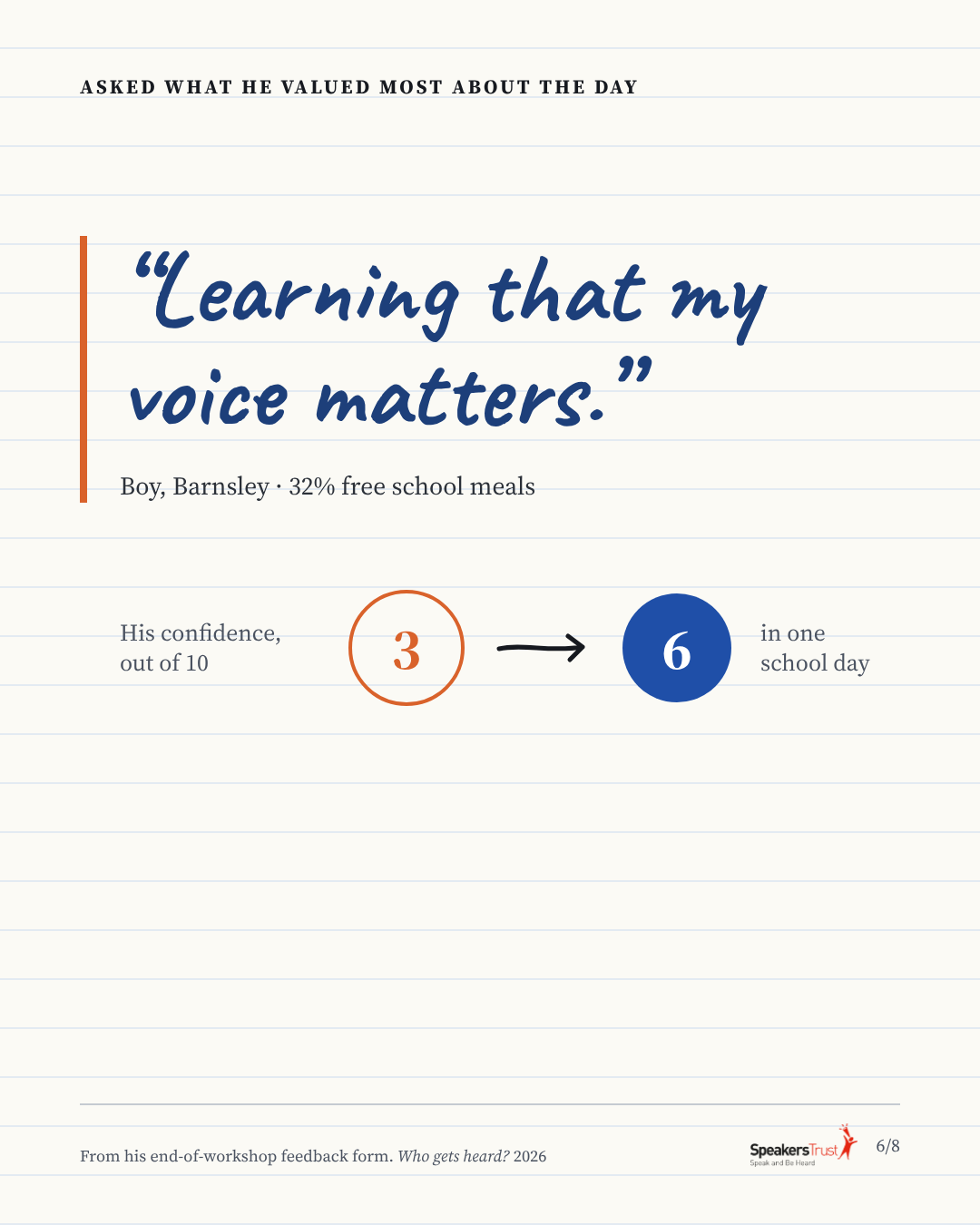
What young people and teachers wrote on their feedback forms at the end of the day. Pick a theme, then swipe through.

Read it, share it

The full report

Sixteen pages: where young people start from, who is left out, why it matters and what works, with the data behind every figure.

PDF · 3.6 MB · Edition 1, November 2026

The four-page summary

The whole argument on four A5 pages, for a meeting or a busy reader.

PDF · 0.8 MB

Images to share

Eight cards sized for LinkedIn (1080 × 1350). Tap one to save it.

Suggested post

Fewer than 1 in 4 young people in England’s state secondary schools feel confident speaking in front of a group. That is the headline from Who gets heard?, a new report from Speakers Trust drawing on what more than 200,000 young people have told them about their speaking confidence. An affluent boy in London is more than twice as likely to be a confident speaker as a less affluent girl outside London. And in one school day, the share of confident speakers doubles. Every young person should leave school with the confidence to speak in front of a group.

Citing the report

Speakers Trust (2026). Who gets heard? Speaking confidence in England’s state secondary schools. Edition 1, November 2026.

Press and enquiries

Russell Findlay, Chief Executive: russell@speakerstrust.org

About the data

The same question, asked the same way, of 213,355 young people.

WHAT WE ASK

Every young person in our workshops answers the same short questions on paper, from 1 to 10, at the start and end of the day: 213,355 since 2019, mostly in Year 10, in more than 1,000 state secondary schools in every English region. 7 or more counts as confident. More than 4 million answers in all.

HOW THE NATIONAL FIGURES ARE MADE

National figures are weighted to England’s state secondary pupils by region, gender and free school meals. The one-day figures use matched start and end answers from 8,206 young people, September to October 2026.

WHAT IT CAN AND CANNOT TELL US

Schools choose to work with us, so this is not a random sample, but it is large, national and consistent. Confidence is young people’s own rating: that is the point of asking them, and it is why we also report the University of Cambridge-led controlled evaluation of oracy skill.

OTHER SOURCES

YouGov for Speakers Trust (2,010 adults aged 18–39, March 2026); our teacher survey (108 teachers, 2024); neaco, Raise Your Words (2024/25).